


What Is Industrial Indoor Air Quality Testing and Why Does It Matter?
The Importance of Measuring Indoor Air Quality
In industrial environments, the quality of the air workers breathe plays a direct role in their health, safety and the performance of the entire operation. While visible dust or haze may signal a problem, many of the most serious airborne hazards are not easily seen. Fine particulates, fumes, vapors and gases can remain suspended in the air long after processes are complete—often at levels that exceed safe exposure limits without obvious visual cues.
Indoor air quality (IAQ) testing is the process of measuring and analyzing airborne contaminants within a facility to understand what workers are actually breathing. These measurements help determine whether exposure levels align with regulatory thresholds such as permissible exposure limits (PELs) established by OSHA, as well as guidance from organizations like ACGIH.
Without accurate data, facilities are left to rely on assumptions. That can lead to underestimating risk, misapplying control strategies or failing to meet compliance requirements. Measuring IAQ provides the foundation for informed decisions; whether the goal is protecting workers, improving system performance or preparing for an audit.
Learn more: Indoor Air Quality Testing Services
How Is Indoor Air Quality Measured in Industrial Facilities?
Industrial IAQ testing is not a one-size-fits-all process. Different methods are used depending on the type of contaminant, how it behaves in the air and what information is needed. In many cases, multiple approaches are combined to build a complete picture of air quality conditions.
Ambient Air Quality Monitoring
Ambient air quality monitoring evaluates the overall concentration of airborne contaminants within a space. Sensors or sampling equipment are placed in fixed locations throughout the facility to measure particulate levels, gases or other airborne substances over time.
This method is useful for understanding general conditions, identifying hotspots and tracking trends across shifts or production cycles. It provides a broad view of air quality, helping to answer questions like:
- Are contaminant levels consistent across the facility?
- Are certain processes generating more airborne material than expected?
- Do conditions change during peak production periods?
However, ambient monitoring alone does not fully capture individual worker exposure. It reflects what is present in the environment, not necessarily what a worker is inhaling at their specific location.


Respiratory Zone Monitoring
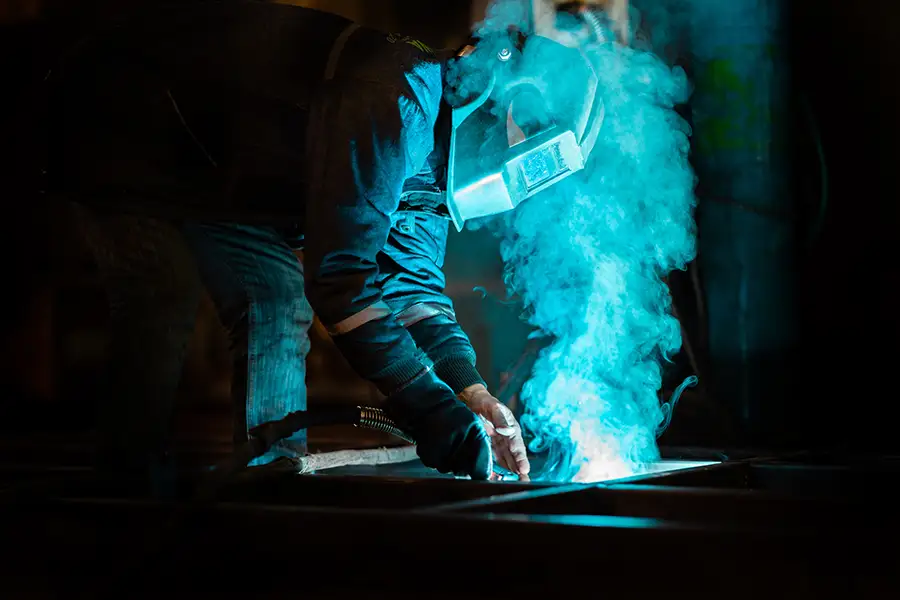 Respiratory zone monitoring focuses on measuring airborne contaminants directly within a worker’s breathing zone; typically within a few inches of the nose and mouth. This is one of the most important methods for evaluating actual exposure levels.
Sampling devices are worn by employees during their shift, collecting data on the concentration of contaminants they encounter throughout their work activities. This approach is essential for:
- Determining compliance with OSHA PELs
- Evaluating exposure during specific tasks or job functions
- Identifying high-risk roles within a facility
Because it reflects real working conditions, respiratory zone monitoring is often the most accurate way to assess whether industrial workers are adequately protected.
Industrial Air Sampling and Laboratory Analysis
In many cases, air samples must be collected and analyzed in a laboratory to identify specific substances and quantify their concentration. This is especially important when dealing with complex or hazardous industrial materials such as metals or chemical vapors.
Sampling may involve filters, sorbent tubes or other media designed to capture contaminants over a defined period. The samples are then sent to a lab for detailed analysis, which can determine:
- Particle size distribution
- Chemical composition
- Toxicity
This level of detail is critical for understanding the nature of the hazard and selecting appropriate control strategies. For example, knowing whether dust is combustible or toxic will significantly influence system design and safety measures.
When Should You Measure Indoor Air Quality?
Indoor air quality testing is typically performed at key points in a facility’s lifecycle or when conditions change. Common triggers include:
- Baseline testing during new facility startup or system installation
- Process changes that may introduce new contaminants or alter airflow
- Employee concerns related to dust, odors or respiratory symptoms
- Compliance preparation ahead of inspections or audits
- Performance issues such as visible dust buildup or inconsistent airflow
- Incident response following a near miss, equipment failure or safety concern
Regular monitoring may also be implemented to ensure conditions remain stable over time, particularly in environments with variable production demands.
Setting Indoor Air Quality Targets
Once data is collected, the next step is determining what acceptable air quality looks like for the facility. This is typically based on a combination of regulatory requirements and internal safety goals.
Regulatory benchmarks such as OSHA Permissible Exposure Limits define the maximum allowable exposure levels for specific substances. However, many facilities choose to aim below these limits to provide an additional margin of safety and account for variability in real-world conditions.
In some cases, targets may also be influenced by:
- Industry best practices
- Corporate safety standards
- Specific process requirements
- The presence of sensitive populations or high-risk tasks
Establishing clear targets helps guide decision-making and provides a measurable standard for evaluating system performance over time.
Turning Baseline IAQ Data into Better Mitigation Decisions
Collecting data is only the first step. The real value of indoor air quality testing lies in how that information is used to improve conditions within the facility.
Baseline IAQ data can reveal where contaminants are generated, how they move through the space and where workers are most at risk. This insight allows for more precise and effective mitigation strategies, such as:
- Designing or refining dust collection systems for better source capture
- Adjusting airflow patterns to eliminate dead zones or recirculation
- Right-sizing equipment based on actual contaminant loads
- Prioritizing high-impact improvements rather than broad, unfocused changes
It also creates a benchmark for future comparison, making it easier to evaluate whether changes have improved air quality or introduced new challenges.
Ultimately, measuring IAQ transforms air quality management from reactive to proactive which supports long-term worker health, regulatory compliance and operational efficiency.
Schedule a Consultation
If you’re looking to better understand your facility’s air quality or turn testing data into actionable improvements, schedule a consultation with our team to start building a clearer path forward.


