


Ventilation and Emissions Control Solutions for Painting and Coating
Painting and coating operations, such as automotive paint booth and aerospace coating operations, require ventilation solutions that are engineered for the specific application, part size, coating chemistry and facility layout. RoboVent designs customized systems that integrate containment, exhaust fans, filtration and airflow management to control overspray, aerosols and vapors while supporting consistent airflow and regulatory compliance.
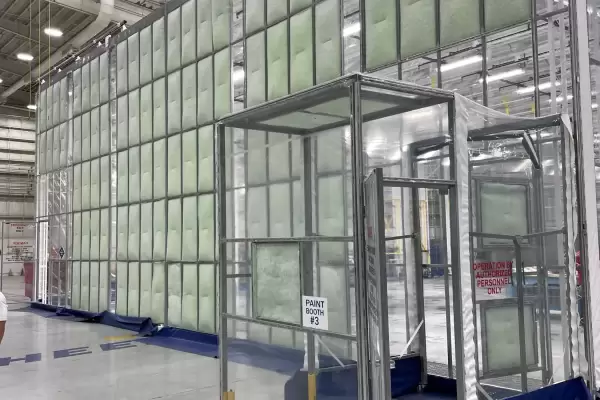
Our engineers bring deep experience designing solutions for industrial coating environments, including large open bays and variable production workflows. For many applications, solutions incorporate DuroRoom® modular enclosures to create a retractable paint booth environment with predictable airflow and effective overspray capture. Systems are tailored to meet process requirements, airflow standards and facility constraints without disrupting production or adjacent operations.

Air Quality Challenges in Painting and Coating Operations
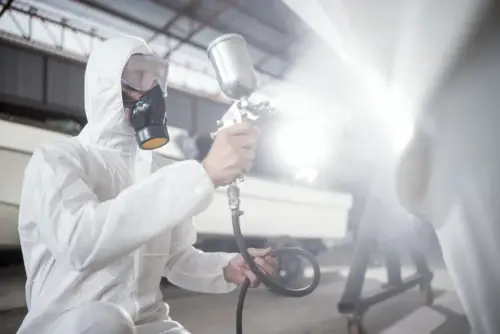
Painting and coating operations introduce airborne contaminants that behave differently from dust or welding fumes. Effective control depends on containment, airflow direction and proper ventilation design to manage overspray and vapors before they spread beyond the application area.
- Overspray Generation: Spray application produces airborne paint droplets that do not adhere to the target surface. Overspray can remain suspended in the air, migrate into adjacent work areas and accumulate on equipment, floors and structural surfaces if not properly captured.
- Aerosols and Paint Mist: Fine aerosols generated during spraying are easily inhaled and can travel long distances without controlled airflow. These particles can reduce visibility, affect coating quality and increase worker exposure in open or poorly contained environments.
- Solvent Vapors and VOC Emissions: Many coatings release volatile organic compounds during application and flash-off. These vapors can accumulate quickly in enclosed or inadequately ventilated areas, contributing to inhalation risk and regulatory compliance challenges.
- Airflow Management in Large or Open Bays: Coating large parts or assemblies often occurs in open or semi-contained bays where maintaining consistent airflow is difficult. Inadequate airflow design can lead to turbulence, dead zones and uneven contaminant capture, allowing overspray and vapors to escape the intended work area.
- Filter Loading and System Performance: High overspray volumes can rapidly load paint booth filters, reducing airflow and capture efficiency. Poorly maintained filtration can compromise ventilation performance and increase emissions within the workspace.
Health and Safety Considerations for Spray Booth Operation

Airborne emissions from painting and coating operations can pose significant respiratory and occupational health risks if not properly controlled. Exposure concerns are driven by overspray, aerosols and solvent vapors rather than thermal fumes or dry dust.
- Inhalation of Paint Aerosols and Overspray: Airborne paint droplets can be inhaled deep into the respiratory system. Prolonged exposure may contribute to respiratory irritation, reduced lung function and increased sensitivity to coating chemicals, particularly in high-volume spray environments.
- Exposure to Solvent Vapors and VOCs: Solvent-based coatings release vapors that can cause headaches, dizziness and irritation of the eyes, nose and throat. Repeated or prolonged exposure may increase the risk of long-term health effects, especially when ventilation is inadequate or inconsistent.
- Chemical Additives and Coating Constituents: Industrial coatings contain a range of pigments, binders and performance additives that may present inhalation risks when aerosolized during spraying. Depending on the coating formulation, airborne exposure may include heavy metals such as chromium, lead or cadmium used in certain pigments, as well as organic compounds found in binders, resins and curing agents. Some coatings may also contain isocyanates or other sensitizing compounds that can contribute to respiratory irritation, asthma-like symptoms or long-term sensitization. Effective capture, filtration and ventilation are essential to limit worker exposure to these materials and prevent their migration beyond the coating area.
- Cumulative Exposure in Poorly Contained Areas: When overspray and vapors are not adequately contained, contaminants can spread throughout the facility. This increases cumulative exposure for workers outside the immediate coating area and complicates exposure monitoring and control efforts.
Regulatory Compliance for Painting and Coating Operations
Painting and coating operations are subject to multiple occupational safety, fire protection and environmental regulations due to the generation of overspray, aerosols and solvent vapors. Proper ventilation, containment and filtration are essential not only for worker protection but also for meeting compliance requirements across industrial coating environments.
- Worker Health and Safety: Employers must control worker exposure to airborne paint aerosols, solvent vapors and coating constituents generated during spray application and flash-off. Occupational Safety and Health Administration (OSHA) standards for spray booths require adequate ventilation for spray finishing operations to limit inhalation risks associated with volatile organic compounds, sensitizers and other hazardous substances present in industrial coatings. Effective capture and airflow control are critical to maintaining compliance with OSHA permissible exposure levels (PELs) for specific constituents, including solvents and heavy metals.
- Fire and Explosion Protection Requirements: Painting and coating operations that use flammable or combustible materials must be designed to control fire and explosion risks associated with overspray and solvent vapors. Fire protection requirements for spray finishing are defined by consensus standards developed by the National Fire Protection Association (NFPA), including NFPA 33, which establishes requirements for spray booths, spray rooms and spray areas. These standards address ventilation rates, airflow direction, overspray capture, ignition source control and electrical classification to prevent the accumulation and ignition of flammable atmospheres.
- Environmental and Emissions Compliance: Many industrial coating operations are subject to federal and state air quality regulations, such as S. Environmental Protection Agency Clean Air Act requirements, that limit emissions of volatile organic compounds and hazardous air pollutants. Depending on the industry and coating type, facilities may be required to demonstrate effective capture and control of overspray and vapors to support permitting, reporting and emissions reduction efforts. Properly engineered ventilation and filtration systems help reduce uncontrolled releases and support compliance with applicable environmental regulations.
Considerations in Ventilation and Containment Design for Industrial Painting and Coating
Painting and coating operations present a distinct set of air quality challenges driven by overspray behavior, solvent vapor generation and the need for controlled airflow. Effective paint spray booth design must address these challenges holistically through integrated containment, ventilation and filtration solutions.
- Overspray Containment and Migration Control: Overspray is the primary challenge in spray finishing operations. Without proper containment, airborne paint droplets can migrate into adjacent work areas, contaminate equipment and compromise indoor air quality. Enclosing the spray area within a paint booth or spray booth creates a defined envelope that allows airflow to be directed toward exhaust points. In facilities coating large parts or operating in crane-served bays, retractable paint booth options, such as the DuroRoom, provide containment when spraying is active while preserving open space for material handling when coating is complete.
- Airflow Direction and Capture Effectiveness: Simply enclosing the spray area is not enough. Airflow direction and velocity must be engineered to consistently move overspray and vapors away from operators and toward exhaust and filtration systems. Poorly designed airflow can create turbulence or dead zones that reduce capture efficiency and affect finish quality. Crossdraft, downdraft or side-draft airflow patterns are selected based on part geometry, operator position and coating method to ensure predictable contaminant movement.
- Exhaust Capacity and Vapor Removal: Paint booth exhaust fans play a critical role in preventing the buildup of overspray and solvent vapors. Exhaust capacity must be properly sized to maintain airflow without disrupting the coating process. In applications using flammable coatings, paint booth exhaust equipment may require additional design considerations, including explosion-resistant construction, depending on coating chemistry and applicable standards.
- Filtration and System Performance Over Time: Overspray loading places significant demands on paint booth fans and filters. As paint booth filters load with pigments, airflow can drop quickly if filtration is not properly staged or maintained. Filtration strategies must account for coating type, overspray volume and maintenance intervals to ensure consistent system performance and avoid unintended emissions back into the workspace.
- Make-Up Air and Pressure Balance: Continuous exhaust from a paint booth ventilation system must be balanced with sufficient make-up air. Poorly balanced systems can cause pressure imbalances that disrupt airflow patterns, pull contaminants out of the booth or negatively affect coating quality. Air makeup units should be integrated into the overall system design to maintain stable airflow, thermal comfort and consistent capture. In some setups, high and low pressure zones may be used to minimize migration to other parts of the facility.
- Flexibility for Large Parts and Variable Production: Many industrial coating operations handle oversized components or intermittent spray work that does not justify a permanent industrial spray booth. Modular and retractable paint booth solutions address this challenge by providing controlled airflow and containment when needed while allowing the space to be reconfigured for other operations. These systems must be engineered to perform like permanent booths when deployed, with proper exhaust, filtration and airflow control.
- Integration With Industrial Finishing Systems: Painting and coating are often part of larger industrial finishing systems that include surface preparation, curing and assembly. Ventilation and containment solutions should be designed with these upstream and downstream processes in mind to prevent overspray migration, cross-contamination and cumulative exposure outside the spray area.
RECOMMENDED SOLUTIONS
DuroRoom
Retractable Industrial Enclosures DuroRoom™ is a flexible process containment system engineer...
Paint & Spray Booth Filters
Paint/Spray Booth Filters A paint spray booth offers a controlled environment for paint to be a...
TOTAL FILTRATION PARTNER
RoboVent is your full turnkey resource for clean air in industrial environments. From facility testing and engineering, to installing equipment, providing replacement filters and preventive maintenance, RoboVent is ready to manage the whole process.


CONTACT US
Contact one of our industrial dust experts to gain the advantage against dust-generating processes and applications.


